Extensive knowledge of slow processes in groundwater purification

During nearly three decades of working as a process engineer and researcher at various drinking water companies, consultancy firms, and Delft University of Technology, I have acquired a deep understanding of the operation and failure mechanisms of groundwater filters. Crucially, the removal of the typical groundwater parameters iron, manganese, and ammonium is slow-reacting processes. Due to the importance of microbiology, both the start-up and the recovery can take months, and tiny details can make the difference between a robust treatment system and a failing one. Over the years, I have gained insight into these critical process conditions and also developed various pragmatic adjustments for process design and operations.
Manganese as a silent killer in groundwater purification
WML's biological groundwater treatment plants (WTP) in Susteren and Pey-Echt have struggled for years since 2000 with a creeping increase in iron and manganese seepage. At WTP Pey-Echt, the continuous manganese seepage caused periodic, serious brown water problems (see Figure 1). This was initially resolved by converting several existing pre-filters into highly loaded post-filters. At WTP Susteren, an unexpected failure mechanism was discovered: the seepage of unoxidized iron through the pre-filters. This caused the backwash nozzles to become severely clogged (see Figure 2), making the filter backwash ineffective. The solution turned out to lie in major maintenance, the use of coarser filter material, and backwashing without expansion. This improved the removal of iron and manganese in the pre-filters, increased production capacity by 30%, and halved backwash water loss.
Read the full article here on the website of the journal H2O, or download the PDF version here.
Copper limitation elegantly resolved in drinking water nitrification in the Netherlands
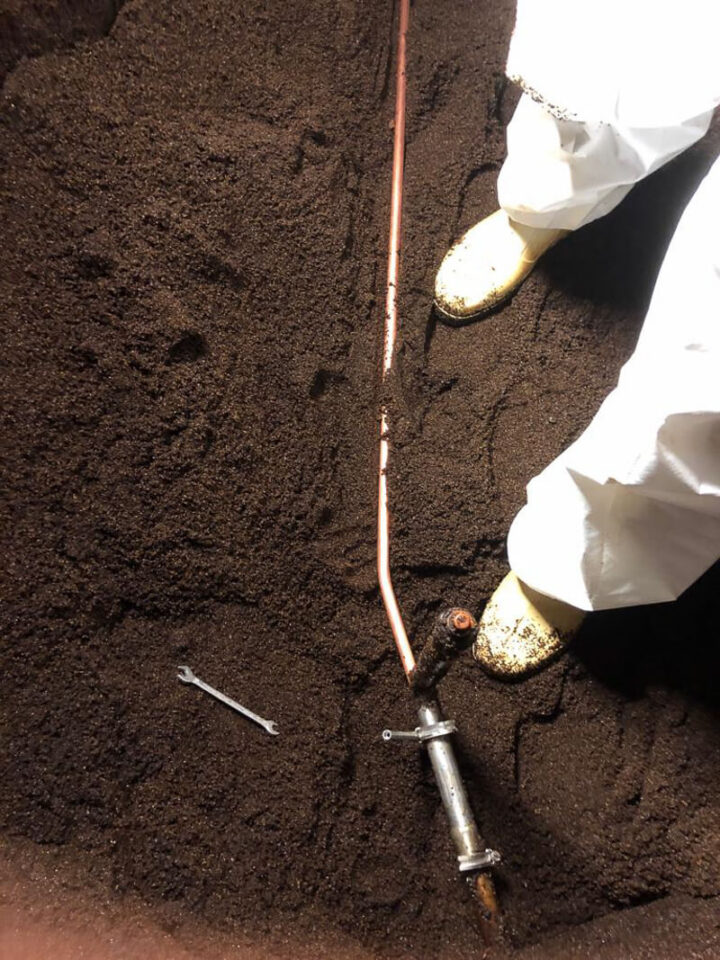
After a large-scale renovation in 2016-2017 of the Oirschot groundwater pumping station of drinking water company Brabant Water, nitrification remained incomplete. Within a few years, this even led to a partial loss of production capacity of 3 mm³/year. The problem was caused by the limitation of the essential micronutrient copper after the wooden risers with copper sleeves in the pumping wells were replaced by PVC. After successful tests with a highly diluted nutrient cocktail, a permanent solution was implemented by installing copper pipes in the filters (see Figure 3). In this way, a robust treatment system with increased and flexible production capacity was restored in a very cost-effective manner.
Read the full article in English here in PDF.
A tailor-made solution for your own groundwater filtration
Every combination of local groundwater quality and treatment setup is unique. I'd be happy to discuss the design or optimization of a robust groundwater treatment system with you, tailored to your specific situation.